

The world of K-pop has seen numerous milestones over the years, with BTS continuously breaking records and paving the way for the genre’s global recognition. However, when one of its members, RM, achieves a historic feat as the highest-charting Korean soloist on Spotify’s Global Top Artists chart, it signifies something even more remarkable. This accomplishment is not just about personal success; it reflects a shift in the global music industry and highlights the evolving recognition of K-pop soloists.
RM, the leader of BTS, has long been celebrated for his artistic vision, lyrical prowess, and deep understanding of music. Unlike many idols who focus solely on performance, RM has established himself as a rapper, songwriter, and producer with a keen sense of storytelling. His music transcends the typical K-pop formula, often incorporating elements of jazz, hip-hop, R&B, and indie rock. His solo work, particularly his albums Mono (2018) and Indigo (2022), received widespread acclaim for their introspective themes and genre-blending soundscapes. RM’s latest achievement on Spotify is a testament to the fact that his music resonates with listeners on a deeper level, far beyond the dedicated BTS fanbase.
K-pop has predominantly been recognized for its group dynamics, where the collective energy of multiple members creates a powerful impact. While soloists like IU, Taeyeon, and Baekhyun have built impressive careers, the genre has often struggled to gain the same traction for individuals as it has for groups. RM’s unprecedented success in the global charts breaks this mold, proving that K-pop soloists can stand shoulder to shoulder with international artists in terms of streaming numbers and recognition.
The Spotify Global Top Artists chart has traditionally been dominated by Western musicians, making RM’s feat even more significant. To achieve such a high ranking on a platform as influential as Spotify speaks volumes about his worldwide reach, the diversity of his fanbase, and the universality of his music. His ascent on the chart serves as an inspiration for other K-pop soloists to push creative boundaries and aim for similar success.
RM’s record-breaking achievement isn’t just about numbers—it represents a shift in the global music industry’s perception of non-Western artists. Historically, Asian artists have faced challenges in gaining mainstream recognition, often being confined to niche audiences or specialized charts. However, the rise of streaming platforms like Spotify has democratized music consumption, allowing artists from diverse backgrounds to gain exposure without the barriers traditionally imposed by the Western-centric music industry.
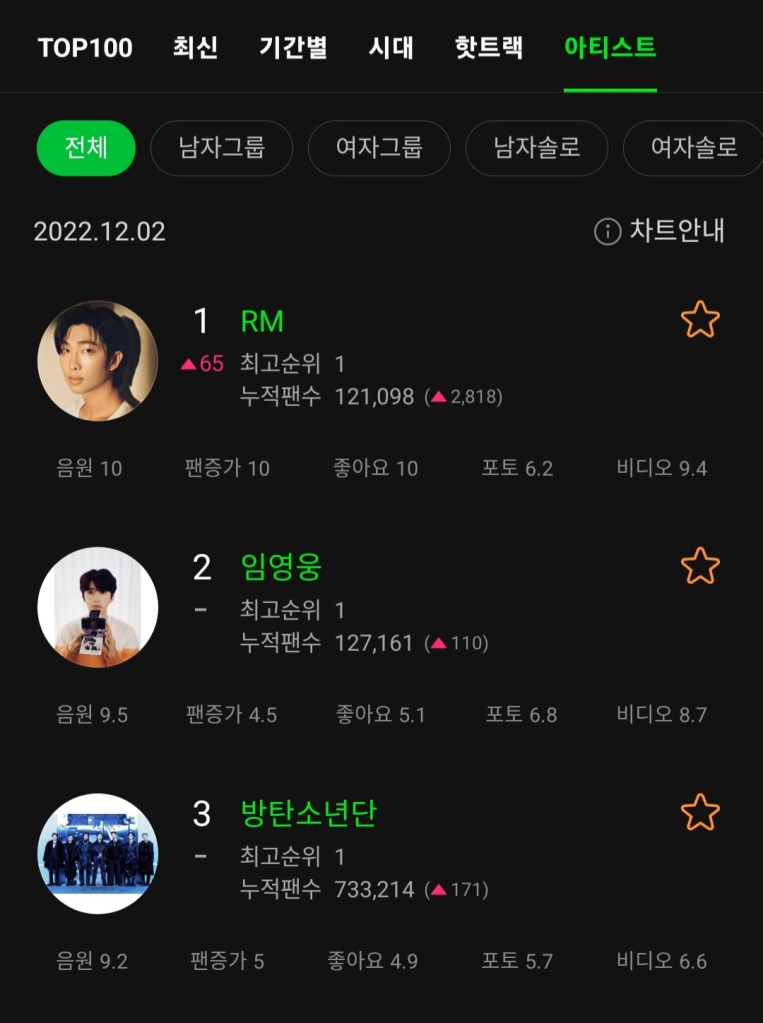
“I barely had time to concentrate on my personal stuff bc BTS was so busy & hectic for a decade. I feel like I was destined to release this in the last month of my 20s… I feel rly happy to release this album right before I turn 30, so I could rate my 20s”
RM’s presence on the global charts challenges outdated industry norms and reinforces the idea that language is no longer a barrier to musical appreciation. Much like Latin artists such as Bad Bunny and J Balvin have conquered the mainstream without singing in English, RM’s success underscores the growing acceptance of Korean music as a legitimate force in the global market.
It would be impossible to discuss RM’s Spotify milestone without acknowledging the unwavering support of BTS’ fandom, ARMY. Known for their dedication, strategic streaming efforts, and global presence, ARMY played a crucial role in propelling RM’s solo work to new heights. However, what sets RM apart is that his music has managed to attract listeners beyond the BTS fanbase. His unique artistry and introspective lyricism have drawn in casual listeners, music critics, and even non-K-pop fans who appreciate his raw storytelling and musical experimentation.
This broadening appeal is crucial because it suggests that RM’s success isn’t merely a byproduct of BTS’ existing influence but rather a testament to his individual artistry. It marks an important moment in the industry where K-pop soloists can achieve mainstream success without being solely defined by their group affiliations. RM’s success on Spotify could signal a new era for K-pop soloists. While groups will always be a dominant force in the genre, more idols may feel encouraged to explore solo careers that push creative boundaries. As more K-pop artists experiment with their sounds and personal artistic identities, we might see a shift where individual members receive the same recognition as their groups.
This trend is already becoming evident with artists like Agust D (SUGA), J-Hope, and even former K-pop idols who have pursued solo careers. The ability to rank high on global streaming charts can help K-pop soloists carve out their unique spaces, making room for diverse musical narratives that aren’t constrained by the expectations of their groups.
RM’s milestone as the highest-charting Korean soloist on Spotify’s Global Top Artists chart is more than just a personal victory—it is a moment of recognition for K-pop as a whole. His success signifies a changing landscape in the global music industry, where talent, artistry, and storytelling are valued regardless of language or origin.
As streaming continues to redefine the way we consume music, RM’s achievement paves the way for future K-pop soloists to dream bigger and aim higher. His artistry, dedication, and authenticity have set a new standard, proving that the impact of Korean music is here to stay. And for fans and music lovers alike, this milestone is not just an isolated success—it’s a celebration of what’s to come in the ever-evolving world of global music.
Discover more from borahae bulletin
Subscribe to get the latest posts sent to your email.
 borahae bulletin