
HYBE, the music company developed alongside BTS and founded by Bang Si Hyuk, has risen to become the fourth-largest company in the global music industry by market capitalization, behind Universal Music Group, Sony Music Entertainment, and Warner Music Group, largely due to BTS’s success. Sure! Here’s a more polished and engaging rewrite of your sentence:
HYBE’s ascent in the global music industry is entirely thanks to BTS’s unparalleled success. Through their extraordinary talent and relentless dedication, BTS rescued a struggling company, became a cultural phenomenon, and even contributed to boosting South Korea’s GDP. They surpassed Korea’s Big 3 entertainment companies nine years ago—and now, they’re competing with the Big 3 of the U.S. music scene.
In recent years, HYBE Corporation has emerged as a formidable force in the global music industry, challenging the longstanding dominance of the “Big Three”—Universal Music Group, Sony Music Entertainment, and Warner Music Group. As of March 2025, HYBE’s market capitalization reached approximately $6.67 billion USD, underscoring its significant growth trajectory.
HYBE’s ascent can be attributed to its strategic diversification and global expansion efforts. Initially recognized for managing BTS, the company has broadened its portfolio by acquiring and collaborating with various international entities. Notably, partnerships with Universal Music Group’s Geffen Records led to the debut of KATSEYE in June 2024, exemplifying HYBE’s commitment to integrating K-pop methodologies into the U.S. market.
In 2024, HYBE reported record revenues of KRW 2.2545 trillion ($1.654 billion USD), marking a 3.5% year-on-year increase. Despite this, the company faced a 37.5% decline in operating profit and recorded a net loss of KRW 3.38 billion ($2.48 million USD). These challenges were primarily due to BTS’s temporary hiatus for mandatory military service and substantial investments in new ventures such as the Weverse platform and gaming initiatives.
HYBE’s market capitalization positions it ahead of other South Korean entertainment companies like SM Entertainment and JYP Entertainment, which have market caps of $1.47 billion and $1.61 billion USD, respectively. However, it remains smaller compared to the global giants of the industry. Looking ahead, HYBE plans to continue its “multi-home, multi-genre” strategy, aiming to blend K-pop systems with local cultures in various markets. The anticipated return of BTS from military service is also expected to bolster the company’s performance.
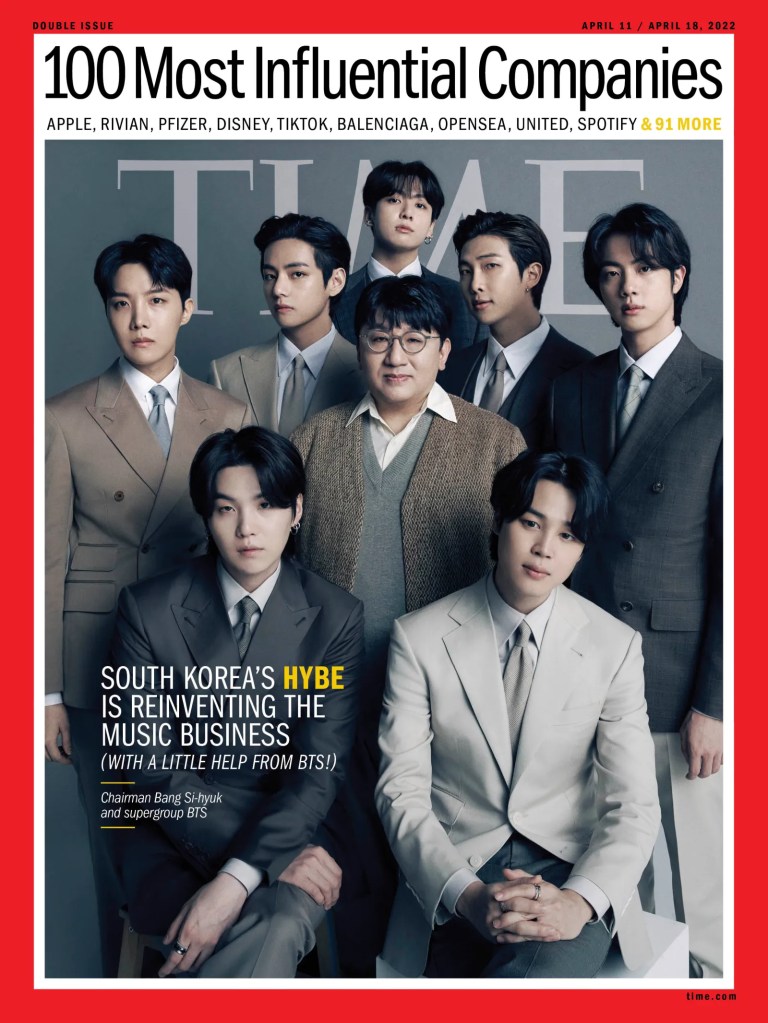
In 2022 HYBE was named “TIMES’s 100 Most Influential Companies”
HYBE’s rise reflects a transformative shift in the global music industry, illustrating how innovative strategies and diversification can challenge established hierarchies. As the company navigates future opportunities and challenges, its trajectory will likely offer valuable insights into the evolving dynamics of global music entertainment.
The History of HYBE Corporation
Once a small music label struggling to survive in the fierce world of South Korea’s entertainment industry, HYBE Corporation—originally founded as Big Hit Entertainment in 2005—transformed into a global cultural powerhouse through a mixture of bold risk-taking, innovative thinking, and the meteoric success of artists who would go on to define a generation.
At the heart of it all stood Bang Si-hyuk, a visionary producer and entrepreneur. Known as “Hitman” Bang, he wasn’t new to the industry when he started Big Hit. With a background as a producer under JYP Entertainment, he set out to build something different—an environment where artists could grow with more creative freedom, where music wasn’t just a product, but a story and an experience.
The turning point came in the early 2010s with the formation of BTS, a seven-member boy group that debuted in 2013. Initially met with modest success, BTS broke through the barriers of the K-pop system by engaging with fans on a personal level, using social media, and addressing themes like mental health, societal pressure, and self-love. As BTS soared in global popularity, Big Hit’s fortunes followed.
In 2013, Big Hit debuted BTS, its top-billed act and the driving force behind its global success. Between 2017 and 2020, BTS achieved unprecedented success—topping charts, selling out stadiums worldwide, and becoming cultural icons. But Bang Si-hyuk knew the company couldn’t rely on one group forever. He began expanding.
In January 2017, Big Hit Entertainment donated ₩30 million to the 4/16 Sewol Families for Truth and A Safer Society, an organization connected to the families of the sinking of MV Sewol. In June 2020, Big Hit, together with BTS, donated $1 million in support of the Black Lives Matter movement, during the George Floyd protests and another $1 million to Live Nation’s Crew Nation campaign to help support live music personnel during the COVID -19 pandemic.
In March 2020, Fast Company named Big Hit one of its most innovative companies of the year. Seven months later, the company issued its IPO on South Korea’s KOSPI, the country’s main stock exchange, achieving a market capitalization of 8.7 trillion South Korean won ($7.6 billion) by the close of its first trading day.
Big Hit Entertainment was rebranded as HYBE Corporation in 2021, marking a shift from being just a music label to a multifaceted entertainment and lifestyle platform. The company diversified rapidly—acquiring Pledis Entertainment (home to SEVENTEEN and NU’EST), merging with Source Music (GFRIEND’s label), launching BELIFT LAB with CJ ENM (which would debut ENHYPEN), and even acquiring Ithaca Holdings, the American entertainment company that managed artists like Justin Bieber and Ariana Grande.
BIGHIT Music which manages BTS was established as a separate, private entity, expected to give artists the best working environment and the best content for fans by focusing on the label’s already existing activities of music production, artist management and fan communication.
HYBE didn’t just grow—it evolved. The company expanded into digital platforms with Weverse, a fan community app; launched ventures into games, technology, and webtoons; and began developing its own virtual artist IPs and AI music projects. Today, HYBE stands as a symbol of modern entertainment’s future—a blend of technology, music, culture, and storytelling. It’s not just a label or a company; it’s an ecosystem where global fandom, artist creativity, and business innovation meet.


We wait to find out where HYBE and BTS will be in the next 10 years.
Discover more from borahae bulletin
Subscribe to get the latest posts sent to your email.
 borahae bulletin