
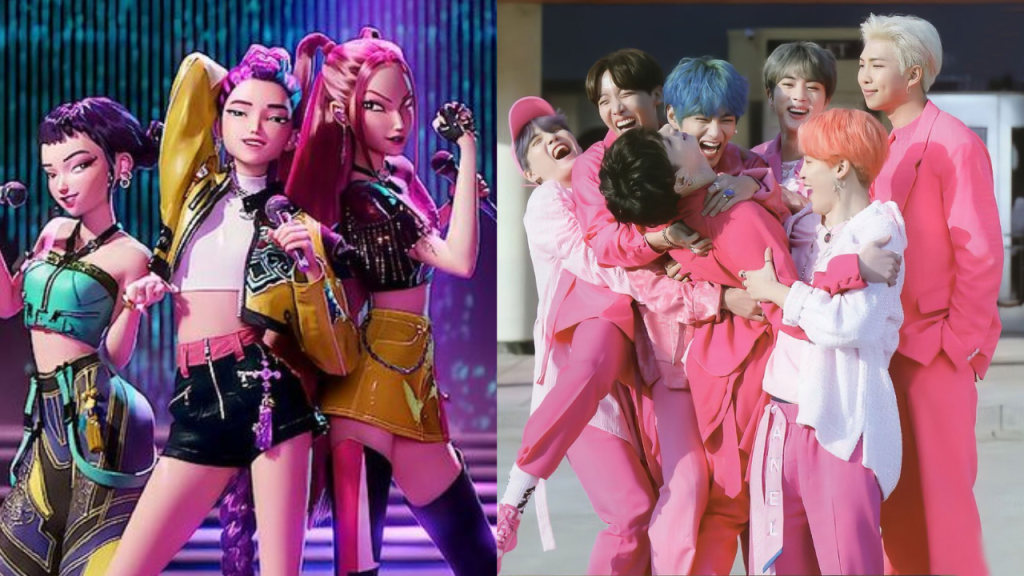
How K-POP Demon Hunters reflects and extends the self-acceptance and self-love themes that BTS has been championing for years. At first glance, K-POP Demon Hunters, an animated film by Sony Pictures Animation, might seem like an action-packed fantasy adventure blending K-pop, martial arts, and supernatural lore. But underneath the glittering visuals and demon-slaying choreography lies a deeper message that resonates with the themes BTS has been sharing with the world for over a decade: self-acceptance, inner strength, and the healing power of community.
BTS has long utilized music as a medium to explore the complex inner landscapes of youth, the pain of self-doubt, the search for identity, and the journey toward loving oneself. Songs like “Epiphany”, “Answer: Love Myself”, and “Magic Shop” offer messages of healing, resilience, and affirmation.
K-POP Demon Hunters, while fictional and stylized, operates with similar emotional stakes. The story follows a K-pop girl group who moonlight as demon hunters, a metaphor that resonates on multiple levels. These “demons” can easily be interpreted not just as supernatural entities, but as manifestations of internal struggles: anxiety, shame, trauma, self-loathing. The act of fighting them is not only about vanquishing external threats, but facing what’s within.
This is exactly what BTS has been preaching: healing begins when you confront the parts of yourself you fear the most.
They both use the stage as a Sanctuary. BTS has often spoken about how music and performing, helped them overcome their darkest moments. From RM’s “The only time I feel alive is when I’m on stage” to SUGA’s honest lyrics about depression and identity in “The Last” and “Amygdala”, the stage becomes a space of transformation.
In K-POP Demon Hunters, the characters balance their glamorous on-stage personas with their off-stage realities, quite literally fighting darkness after the lights go out. It’s a hyper-stylized, fantastical way of saying: “We all wear masks, but we are stronger when we confront what’s behind them.”
This duality mirrors BTS’s constant call for authenticity, that loving yourself includes acknowledging your pain, not hiding it.
Another key parallel lies in the power of community. BTS’s message has never been about solitary healing. They always emphasize connection, whether it’s between the members, with ARMY, or within one’s own support systems. K-POP Demon Hunters celebrates female friendship, solidarity, and found family, showcasing how the protagonists draw strength from each other to fight their battles. In a world that often isolates those struggling with self-worth or identity, the idea that you can lean on others is both radical and necessary.
As BTS said in their 2020 Dear Class of 2020 speech:
“If we can respect ourselves, we can stand up again and move forward.”
But often, it’s the people who believe in us who help us get there.
BTS has also reclaimed and celebrated their Korean identity on a global stage. Songs like “Idol” and “Daechwita” blend traditional Korean elements with modern beats, reinforcing that you don’t have to erase who you are to be accepted; you can succeed because of your roots, not in spite of them.
K-POP Demon Hunters, with its all-Asian cast and Korean cultural references (from hanbok-inspired outfits to traditional myths), reflects this too. The story doesn’t shy away from its identity, instead, it leans into it, showing that cultural pride and global appeal are not mutually exclusive.
This is deeply aligned with BTS’s global mission: breaking barriers while staying true to who you are. In the end, K-POP Demon Hunters may be animated fantasy, and BTS may be real-life icons, but they both deliver a shared message to young people around the world:
You are enough. You are worthy. And the battle to love yourself is one worth fighting, demons, doubts, and all.
In the last scene, where the Huntr/x wins the last fight, they gain more power and strength from the fans around them. This is exactly what ARMY is to BTS, the power they wield when it comes to protecting and propelling BTS to success.
Whether you’re singing on a stage or wielding magical weapons, your power lies in your truth. And like BTS has always said:
“I’m the one I should love in this world.”
Discover more from borahae bulletin
Subscribe to get the latest posts sent to your email.
 borahae bulletin