
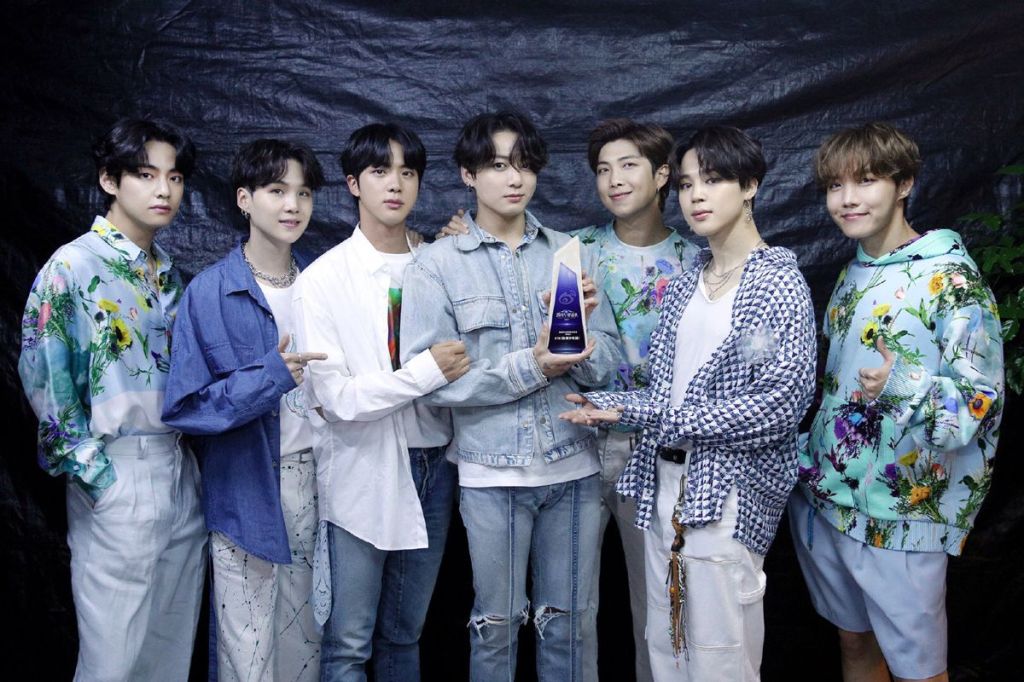
Recently, fans have pushed back strongly against an article suggesting that the relationship between BTS and ARMY is “manufactured” for corporate gain. The backlash is understandable. To reduce one of the most documented, reciprocal artist–fan relationships in modern music to a marketing tactic ignores years of evidence, shared struggle, and emotional transparency that cannot be scripted or replicated. The truth is simple, BTS and ARMY grew together, long before global fame, before billion-dollar valuations, and before the industry understood the power of fandoms the way it does today.
BTS and ARMY is a relationship born before the power. When BTS debuted in 2013 under a small, struggling company, there was no blueprint for global domination. BigHit Entertainment was not a corporate giant; it was a risk-taking startup betting on seven trainees with no guaranteed future. Early ARMYs were not incentivized by popularity or clout. Supporting BTS meant defending them against ridicule, lack of exposure, and industry dismissal.
This matters because manufactured relationships require power and leverage. BTS had neither. What they did have was communication. From their earliest days, BTS spoke directly to fans, not through polished press statements, but through handwritten letters, late-night livestreams, raw lyrics, and behind-the-scenes honesty. They talked about fear, debt, failure, and self-doubt. That vulnerability resonated not because it was profitable, but because it was real.
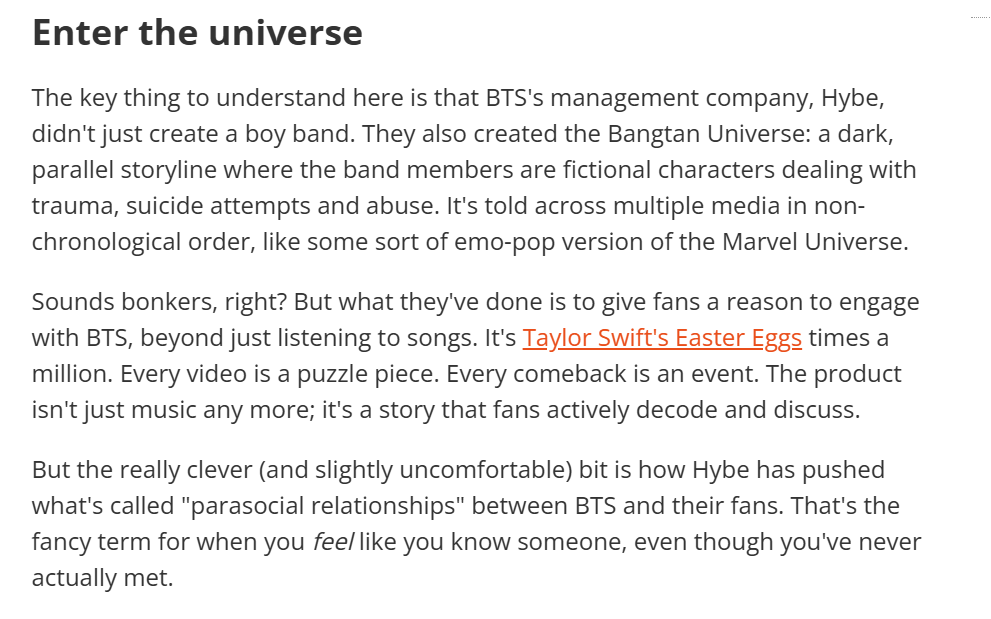
Below is an excerpt of the article that suggests that;
“Hybe has pushed what’s called “parasocial relationships” between BTS and their fans.”
If the BTS–ARMY bond were a corporate illusion, it would crumble under lyrical scrutiny. BTS’s discography repeatedly centers on youth anxiety, societal pressure, mental health, and identity, topics that are commercially risky, especially in idol culture. Songs like “2! 3!”, “Magic Shop”, “Sea”, “We Are Bulletproof: The Eternal”, and “For Youth” are not abstract fanservice. They are explicit acknowledgements of mutual reliance.
BTS does not position themselves above ARMY, but alongside them, often crediting fans not as consumers, but as emotional companions through hardship. A manufactured relationship would prioritize control and idealization. BTS instead encourages autonomy, self-love, and growth beyond fandom. That contradiction alone dismantles the claim.
Corporate relationships tend to collapse when profit is no longer guaranteed. BTS’s relationship with ARMY has done the opposite, deepening during pauses, uncertainty, and absence. During hiatus announcements, military enlistments, and individual paths, BTS did not pivot to silence or vague PR language. They addressed fans directly, often emotionally, reassuring ARMY that separation did not equal abandonment. ARMY, in turn, responded not with entitlement, but patience, supporting solo work, waiting years without pressure for immediate group returns.
“No company can manufacture that level of intertwined trust.”
Additionally, BTS has repeatedly used their platform to redirect attention away from themselves, urging fans to donate to social causes, speak up for mental health, and value their own lives beyond idol worship. A purely profit-driven relationship would never encourage fans to disengage emotionally when needed. ARMY is not a passive audience. One of the most insulting aspects of the “manufactured” narrative is the implication that ARMY lacks agency or autonomy.
ARMY is one of the most diverse, critical, and organized fanbases in the world, spanning ages, cultures, professions, and political awareness. ARMY has challenged BTS’s company, criticized decisions, boycotted when necessary, and openly discussed boundaries. That alone disproves the idea of blind manipulation. Manufactured fandoms rely on obedience whereas ARMY thrives on dialogue and honest communication.
Fans support BTS not because they are told to, but because they see themselves reflected in the music, values, and evolution of the group. This is why the corporate argument falls apart. Yes, BTS is successful. Yes, their company profits. But capitalism benefiting from a relationship does not mean it created it.
Companies did not invent ARMY’s charity projects, scholarship funds, disaster relief efforts, or grassroots organizing. BTS did not monetize those acts. In fact, they often deflect praise away from themselves when fans do good in their name. If the bond were manufactured, it would be fragile. Instead, it has survived scandals, hiatuses, military enlistment, language barriers, cultural backlash, and years of scrutiny.
It is unfortunate that this narrative keeps appearing over and over again. The claim that BTS and ARMY’s relationship is artificial often emerges when people feel threatened by what they cannot replicate. The industry is comfortable with transactional fandoms, but uncomfortable with emotional ecosystems that operate outside traditional control.
BTS disrupted the hierarchy, artists talk with fans, not at them. Fans respond with loyalty, and not ownership. That dynamic challenges outdated power structures, so it is easier to dismiss it as manipulation than to acknowledge its authenticity.
“BTS and ARMY did not use each other. They grew alongside each other.”
BTS grew from insecure rookies into global artists who still speak openly about fear and doubt. ARMY grew from a small, protective fanbase into a global community that values empathy, accountability, and collective care. That kind of growth cannot be bought, scripted, or manufactured.
Calling the BTS–ARMY relationship “manufactured” is not just inaccurate, it erases years of documented history, emotional labor, and two way reciprocal respect. It reduces human connection to marketing strategy and dismisses fans as mindless consumers rather than active participants in a cultural movement.
The truth is uncomfortable for critics but obvious to those who have paid attention. BTS did not create ARMY for profit. ARMY did not support BTS for illusions. They met in sincerity and chose to stay. And that choice, made millions of times over more than a decade, is something no company can fake.
Here are some comments from the article
LynnD3 “This is just so obviously a hit piece by a hater (and I suspect a fan of a different kpop group) or a typical xenophobic American. If, as you say, this “strategy” is so easy, there would be dozens of BTS’s. Trust, many of the other entertainment companies have tried and failed to recreate BTS and ARMY. They say those who cant become critics, and you prove that with this article.”
OT7Gurl. “Someone sent this article to me to read and I feel compelled to respond, as the tone of this piece leans heavily on a tired, patronising narrative: hysterical, parasocial (implicitly female) fans being manipulated by a cynical corporation that “manufactures” idols and extracts profit through engineered emotional dependency. It’s trite, reductive, and frankly boring. This framing has been done to death, and repeating it yet again isn’t insight – it’s intellectual laziness. The author touches on something genuinely interesting, but ultimately doesn’t know enough about BTS or ARMY to develop it in any meaningful way.
Most glaringly, the article treats parasocial relationships as though they’re a novel pathology invented by HYBE and inflicted on unsuspecting girls. They aren’t. Parasocial relationships have been a foundational feature of celebrity culture since the early 20th century, actively cultivated by Hollywood, the music industry, and pop management long before K-pop entered the picture. Presenting this as a BTS-specific phenomenon fundamentally misunderstands both history and media theory.
What does distinguish BTS is not the existence of parasociality, but the strength and reciprocal nature of the connection and that didn’t originate as a top-down master plan cooked up by executives in 2010–2012. It emerged far more organically. BTS’s early lack of resources forced them to rely on direct, unfiltered use of social media at a time when most acts weren’t doing so. That necessity created a two-way dynamic between artists and fans that was improvised, mutual, and unusually transparent.
This early context matters. The BTS–ARMY relationship wasn’t engineered in a lab… it evolved through specific, adversarial conditions and sustained interaction. Yes, the company has increasingly leaned into and formalised that dynamic over time but its origins give it an authenticity and emotional continuity that newer fans can still feel.
The genuinely compelling angle, and the one this article never fully earns, is that BTS and ARMY have become a blueprint for the modern fandom economy. This is why HYBE and others openly talk about studying “the psychology of falling in love.” Not because they’ve cracked a simple formula, but because they haven’t. If this relationship were easily engineered or reliably scalable, the industry would already be flooded with dozens of BTS equivalents.
It isn’t. And that’s the point.
Reducing this phenomenon to “manufactured idols” and “deluded fans” doesn’t just miss the mark, it totally avoids the far more interesting, uncomfortable truth… some cultural forces can’t be fully controlled, no matter how much money, data, or corporate ambition you throw at them.”
Divinesha “I used to be an ARMY, and tbh no one cares about the BTS universe or the games they have created. Those apps are full of bugs and kinda boring. The things that mostly kept us connected included the Run episodes, bloopers, their little chaotic interviews, and ofc their weverse/vlive/ig lives. Even there, many international armies tend to wait for the subtitles. As for the demand-supply scarcity idea and Love psychology thing you mentioned, they’re used by almost every company or profit based organisation, nothing new. Its basic golden rule for sales: sell emotions, not products.”
Marian K1 “I used to be army, so I do recognize the errors here (genuinely no one cares about the Bts Universe), but also reading the comments makes me feel sad so many people of all ages don’t realize that 80% of the “realness” is contrived. And to ignore the things Hybe says in investment calls is so naive. Obviously investors come before fans, but the fans will pay because they believe they need to “support” these millionaires.”
Nicole Capers “Reading these comments, Author, I hope you realize you need to take this article down. You didn’t do your due diligence to gain understanding of BTS’ origins and how that affected Army’s loyalty and protectiveness. You skimmed the surface and thus ignored the their entire body of work, and their talent as a group and as individuals. Your opinion seems to be steeped in bias, disdain, and willful ignorance, and is quite offensive to BTS, HYBE and ARMY. Perhaps clicks and attention were your motivation. ARMY is so attentive and enthusiastic about championing the members and their accomplishments you may, unfortunately, receive the engagement you desired when you published this travesty. For ARMY out there who run across this, BORAHAE 💜💜💜💜💜💜💜. (Another thing the author knows nothing about.)”
Getrude H “For many fans, the connection with BTS members is genuine, supportive and protective. It might be hard to believe but most of us don’t have expectations of reciprocity. We love them just the way they are. It helps that they are talented and wise. However they have managed to allow most of us over 50 army to be vulnerable enough to enjoy kpop music without any judgement. There is a joy we feel when we support them and listen to the beautiful music, watch their Weverse video live streams even if we don’t understand a word of Korean! We just like to look at them fondly.. Yes, it could be an addiction but in moderation. My 56 year old fellow fan said BTS is her comfort zone, and I shared to her that they are my safe zone. My go to when an feeling anxious or frustrated. Listening or watching their videos calms me a lot”
Courtifiedjohnson “BTS is so much more than a carefully constructed cash grab. Their appeal isn’t some fabricated storyline that book nerds consume or an illusion of relationships. I’m 45. I’ve been through the nsync and backstreet boys craze. I know a prefabricated boy band when I see one. BTS works.
The reason why everyone follows these men is because they are real. They show their fans the smoke and mirrors, then they turn on the lights and open the door. They show us the struggle, the fun, and the chaos. And their fans connect to that. We relate to them because they are just like everyone else. 7 normal guys from Korea just trying to do what they love and share some of that with the world. They are actually decent humans, they are humble, and they are kind. They rap without making it all about btches and money. They sing their hearts out and cry with the ones in joy and pain. The family they have created in their group reminds me of the loving chaos my brothers and I have. Like I said, they are real. It’s easy to see just the surface of anything, it’s when you dig deeper you find the truth. 💜”
courtifiedjohnson “I absolutely agree with you! I’m 74 & I enjoyed their music since they debuted. These 7 young men have brought K-pop to the forefront. They care about everyone, no matter what age & nationality. They’ve donated millions of dollars to various charities & care about children! They started out together as boys & they worked very hard to get to where they are today! I’ll be going to my first BTS concert in August & I’m looking forward to it. I know that this probably will be the only time I can go to see them or any concert, because of my age. I’m an Army fan through & through!!”
lmbcox1 “So many falsehoods in this article. The members released over 100 solo songs while they were in the military, meaning they prepared all of this in advance to keep fans engaged. The two members who got out first did world tours. There is not a scarcity of items. We are receiving new merch and restock announcements almost every day. When the tour was announced we did book accommodations. You cannot bring 80k people somewhere and expect there to be a plethora of hotels available. Finally the BU is something most fans dont know about. The members themselves discuss their real life issues such as mental health, disappointment, illness and are relatable on lives. They are genuine and authentic and in today’s world of fake everything, that is pure gold.
This cannot be manufactured


Discover more from borahae bulletin
Subscribe to get the latest posts sent to your email.
 borahae bulletin